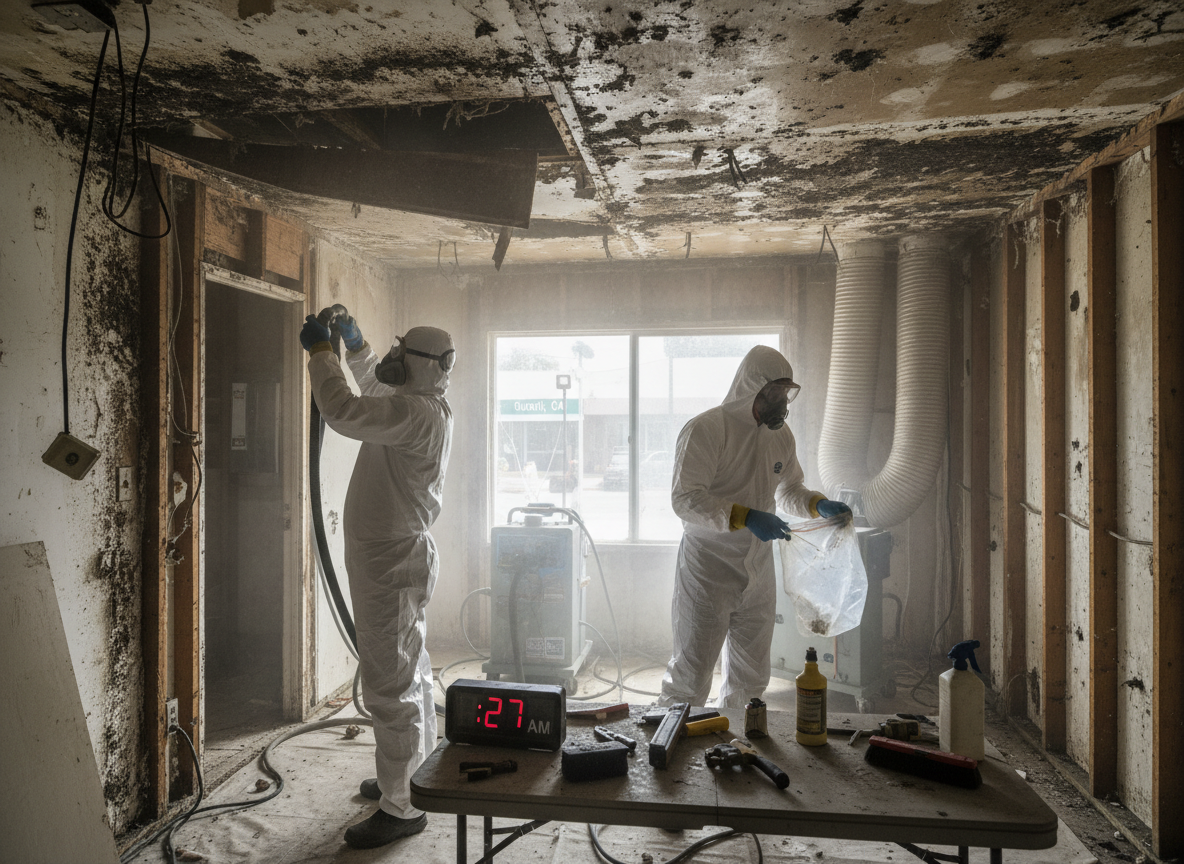
Guasti sits in an older industrial pocket of San Bernardino County where many buildings date to the mid-20th century and sit on concrete slabs that hold moisture after rare heavy rains. When water intrudes through roof penetrations or around loading docks, mold often develops behind drywall and under flooring within 48 hours. Our 24 hour mold removal crews arrive from 323 N Turner Ave ready to isolate the affected zone, set up containment, and begin air scrubbing immediately so the job does not spread to adjacent suites.
Local terrain near the rail lines and Ontario airport creates pockets of poor drainage that keep soil against foundations damp for weeks. This forces us to pull baseboards and check for hidden growth in wall cavities that standard visual inspections miss. We use moisture meters and borescopes on every call because skipping this step leaves colonies that return the next time humidity spikes.
After physical removal we treat surfaces with EPA-registered antimicrobials and run dehumidifiers until readings drop below 50 percent. Homeowners and property managers in Guasti frequently ask about clearance testing; we always recommend an independent lab because it documents the space is safe before re-occupancy. The entire process runs around the clock until the structure is dry and clean.
Technician insight
In Guasti the thing that catches most people out with 24 hour mold removal is the way older tilt-up concrete buildings near the tracks hold water against the slab for weeks after a storm. Homeowners focus on the visible patch on the wall and miss the fact that the moisture is still wicking up from below, so the growth returns inside a month if we do not pull the base plate and treat the joint.
Hidden Growth Behind Loading Dock Office
A small warehouse office near the Guasti rail spur showed black spots on drywall after a December rain. We found the slab edge had stayed wet for three weeks because the parking lot drainage pitched toward the building. Crews removed the lower four feet of wall, treated the concrete, and ran drying equipment for 72 hours straight. Clearance samples came back clean and the tenant moved back in without further interruption.
How it works
- 1
Emergency Assessment
Technician arrives within hours, identifies visible growth, and maps moisture sources using meters and infrared.
- 2
Containment Setup
Plastic barriers and negative air machines isolate the work zone to prevent spores from traveling through HVAC or open floor plans common in Guasti warehouses.
- 3
Removal and Cleaning
Affected materials are cut out, surfaces are scrubbed, and HEPA vacuuming removes remaining spores.
- 4
Drying and Verification
Dehumidifiers and air movers run until moisture levels normalize, followed by optional third-party clearance testing.
Pricing
Cost depends on square footage affected, depth of hidden growth in slab-on-grade buildings, and whether after-hours access or weekend work is required.