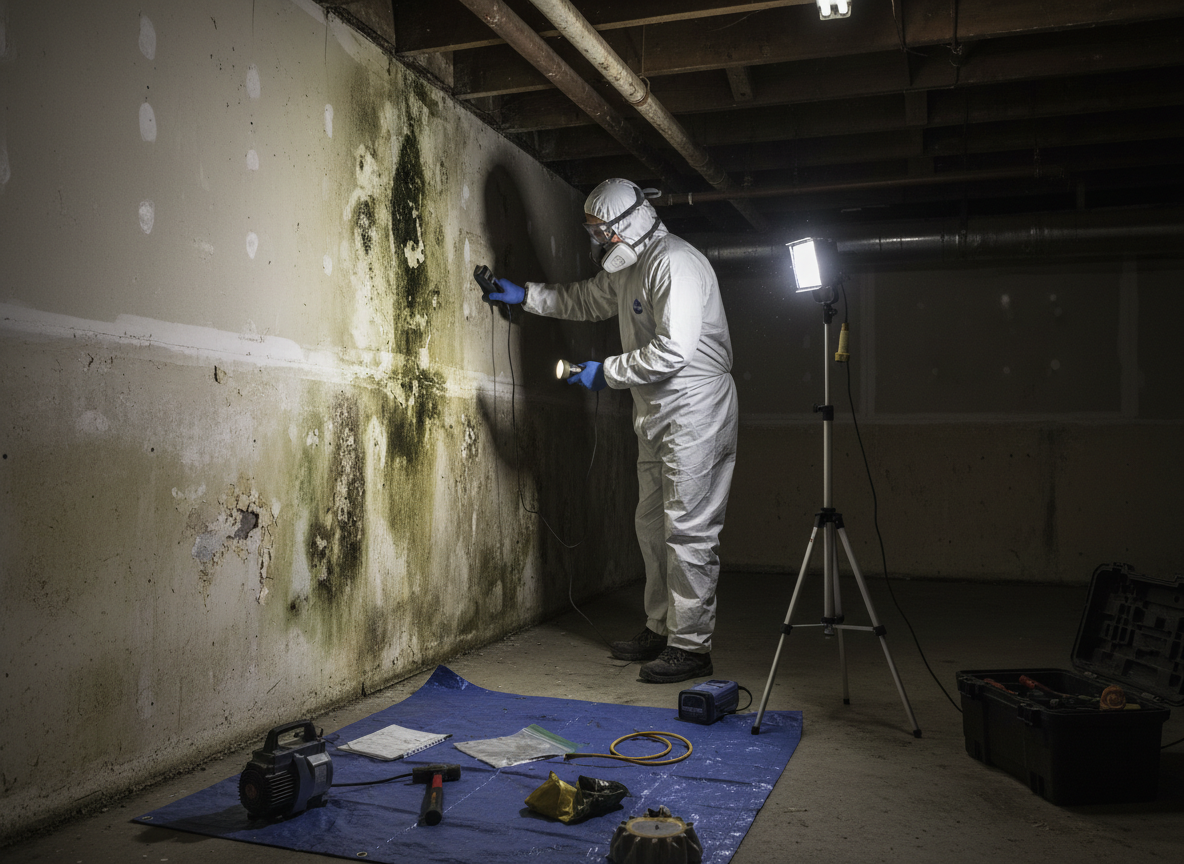
Guasti sits in San Bernardino County amid older warehouse conversions and mid-century homes near the Ontario Airport corridor. These structures often feature slab foundations and limited crawlspaces where summer heat drives residents to run evaporative coolers that can introduce humidity spikes. Winter rains, though infrequent, pool against stucco exteriors and seep into expansion joints, creating hidden moisture pockets behind drywall. A proper inspection maps these pathways with moisture meters and thermal imaging rather than relying on visible discoloration alone.
Inspectors must also account for the area's alkaline soils that retain salts, which can wick upward through porous concrete and foster mold on lower wall plates. In mixed-use blocks along Turner Avenue, commercial refrigeration lines sometimes leak into shared walls with adjacent residences, producing isolated colonies that standard air sampling misses. We document every finding with labeled photos and chain-of-custody notes so property owners can show results to insurers or future buyers without ambiguity.
Common Inspection Triggers in Guasti
Residents typically call after noticing musty odors following the first winter storms or when selling a property built before 1980. We also inspect after roof leaks on flat commercial buildings that have been converted to lofts, where HVAC condensate drains often terminate inside wall cavities.
Technician insight
In Guasti the thing that catches most people out with Mold Inspection is how the flat industrial lots and alkaline soil let winter rain migrate under slab edges into older single-wall construction, so you find active growth three feet up the studs even when the carpet looks dry.
Hidden moisture behind a converted warehouse wall
A homeowner on Turner Avenue noticed a persistent odor after December rains. We mapped elevated moisture along the shared wall with the neighboring unit and pulled tape samples that confirmed Stachybotrys. Containment was installed, the source leak from the adjacent roof drain was sealed, and the wall cavity dried before any visible growth spread to living spaces.
How it works
- 1
Initial Walkthrough
We examine every accessible room, attic, and crawlspace while noting water stains, musty smells, and prior leak locations.
- 2
Moisture Mapping
Digital meters and infrared cameras locate elevated moisture behind surfaces without demolition.
- 3
Air and Surface Sampling
Spore traps and tape lifts are collected from suspect areas and sent to an independent lab for genus identification.
- 4
Report Delivery
A written report with photos, lab results, and prioritized recommendations is emailed within 48 hours.
Pricing
Pricing varies by square footage, number of samples, and access difficulty; upfront quotes provided after the walkthrough.