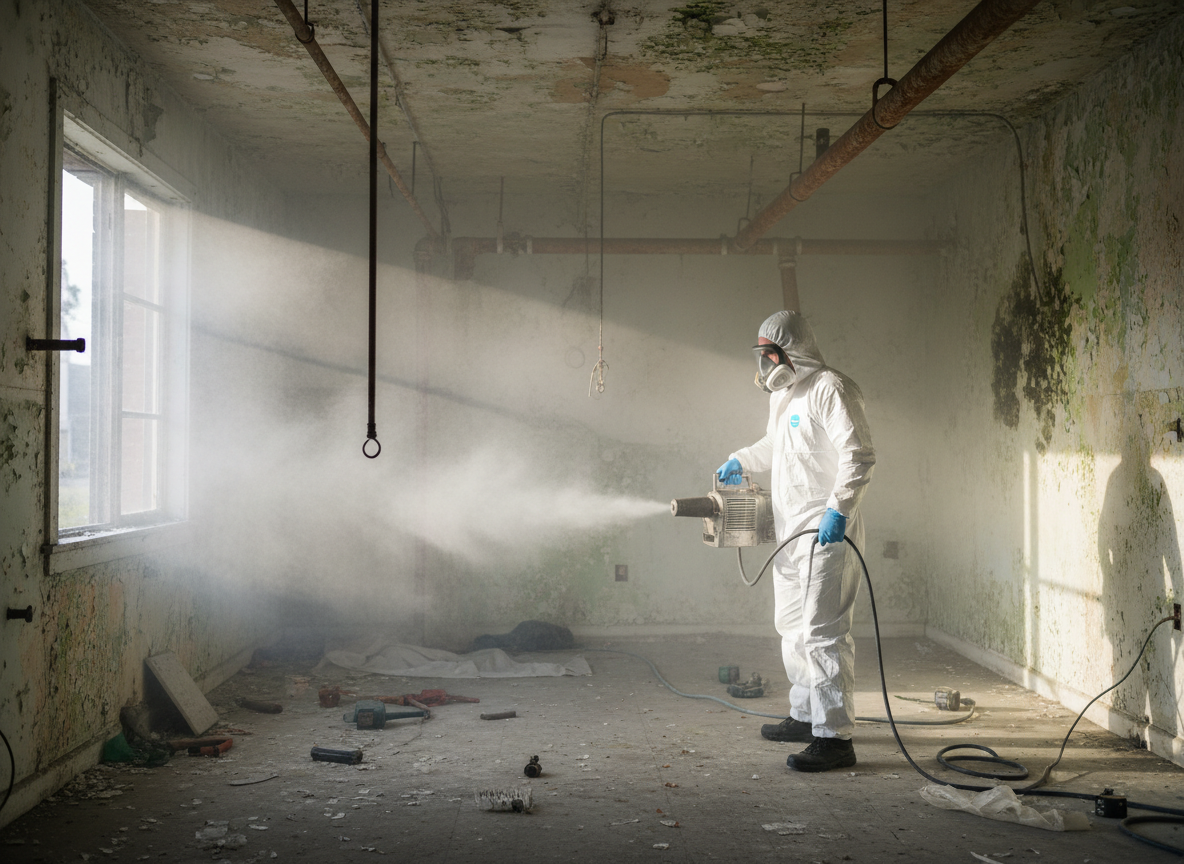
Mold fogging treatment disperses EPA-registered antimicrobial agents as a fine mist that penetrates cracks, attic insulation, and wall cavities typical in Guasti homes built before modern vapor barriers. The process requires sealing HVAC returns first to prevent circulation into living spaces, then running the fogger at low velocity so the particles settle rather than drift. Technicians monitor relative humidity before and after because Guasti's dry Santa Ana winds can mask residual moisture that reactivates spores days later.
In structures along Turner Avenue and surrounding industrial edges, fogging often follows water intrusion from roof penetrations or slab cracks where alkaline soil pushes moisture upward. Operators wear full-face respirators and use negative-air machines to exhaust displaced particles outside, avoiding re-deposition on furniture or textiles. Post-treatment, surfaces must remain undisturbed for several hours so the active compounds can oxidize cell walls without leaving residue that could affect pets or plants kept indoors.
Edge cases include fogging around electrical boxes and recessed lighting where arcing risk rises if moisture is still present. Crews test with moisture meters on drywall and subflooring first, then apply the fog only after confirming readings below 15 percent. Homeowners are advised to replace HVAC filters immediately afterward because trapped spores can load the new media within the first week of resumed airflow.
Technician insight
In Guasti the thing that catches most people out with mold fogging treatment is how quickly dry Santa Ana winds hide ongoing moisture in the stucco-clad homes along Turner and nearby streets; if you fog before the slab or roof leak is fixed the spores rebound within two weeks because the alkaline soil here keeps pushing water upward through older foundations.
Attic spores after roof leak near Turner Avenue
A Guasti homeowner noticed musty air in upstairs bedrooms after winter rains. Inspection found black growth on insulation above a bathroom where flashing had failed. We contained the attic, ran negative air, and applied fogging solution through the rafters. Follow-up readings showed moisture and spore levels returned to normal within 48 hours.
How it works
- 1
Initial Assessment
Technicians inspect attics, crawl spaces, and wall cavities for visible growth and hidden moisture using meters and borescopes.
- 2
Containment Setup
Plastic sheeting and negative-air machines isolate the treatment zone to keep fog from migrating into occupied areas.
- 3
Fog Application
EPA-registered fogging solution is dispersed at controlled particle size to reach surfaces and airborne spores without wetting materials.
- 4
Ventilation and Verification
Spaces are aired out, then rechecked with moisture meters and ATP swabs to confirm spore reduction before clearance.
Pricing
Cost depends on square footage treated, number of cavities accessed, and whether follow-up visits are required after the initial fogging.